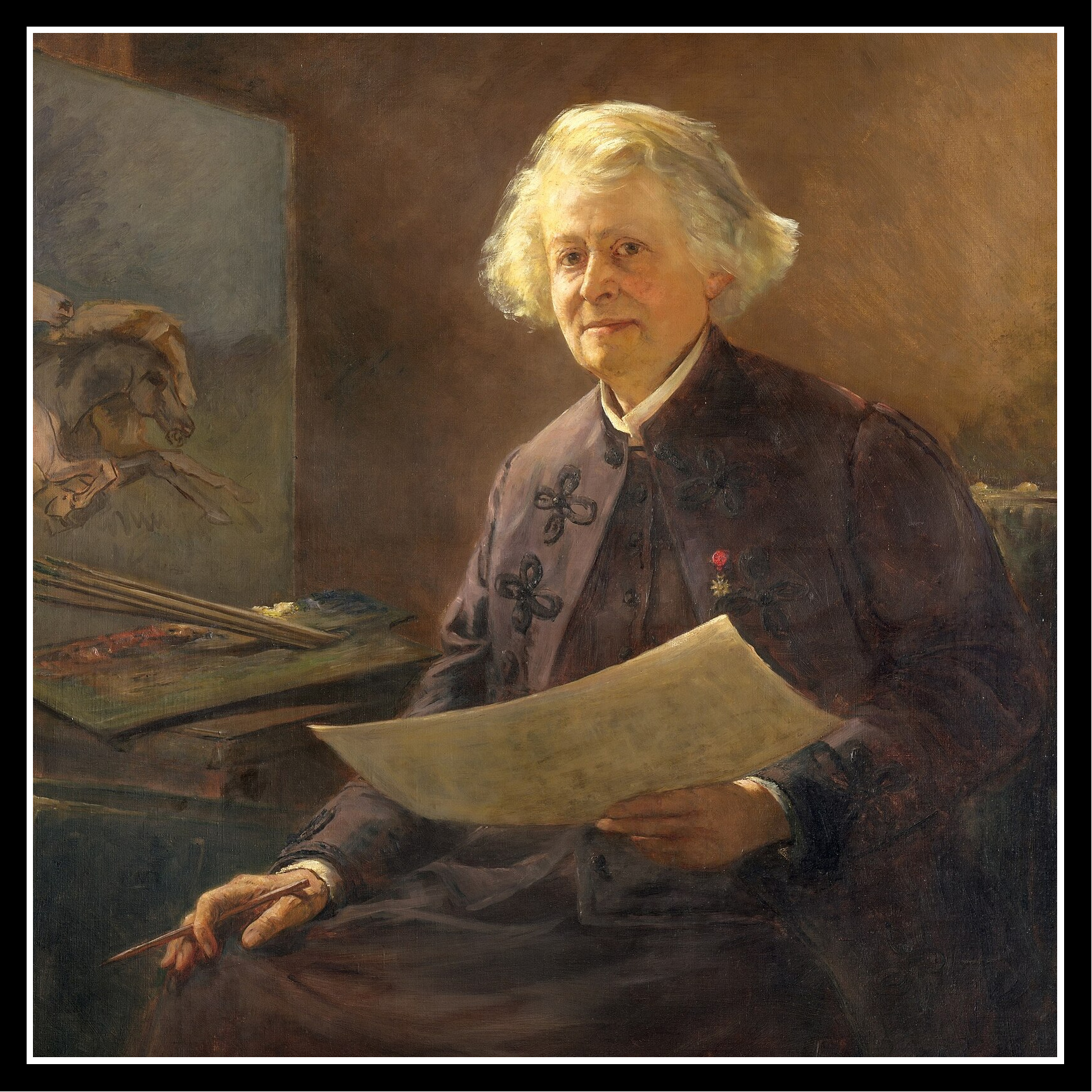
by Anna Klumpke, Rosa circa 1898, age 76 (That look on her face! Excellent.)
Rosa Bonheur was a wild, animal‑obsessed kid who drew before she could read, and knew she was meant for the world of art from an extremely young age.
She didn’t set out to shock anyone; she simply refused to be anything but herself, and the world eventually had to adjust to her as she climbed to the highest of fame as a painter in the 1800s.
Suzanne’s first self-portrait, 1883 age 18How Pierre-August Renoir painted her that same year, 1883 (You’ve seen this one, right?) How Renoir saw her two years later, 1885Casting the Nets, Suzanne Valadon, 1914
Shownotes are under construction, please come back later for all the things Beckett talked about in this episode!
Time Travel With The History Chicks
Books!
by Rosinsky Therese Diamond (The “small” biography)by June Rose (the “middle” book)by Catherine Hewitt ( the “big” book)by Henri Perruchot
Web!
You can visit one of her studios (and the original Le Chat Noir poster) at the Musée de Montmartre! It’s a “must-see” from us for a day spent in Montmartre!
The chateau she lived with Andre Utter, Château de Saint-Bernard, you can visit or even have your wedding there.
We have a Pinterest board for every subject, you should check it out and maybe start with Suzanne’s!
Moving Pictures!
Once again, we have the perfect subject for a movie and Suzanne’s is a story ripe for a biopic! Scandal! Relationships! The rise of an underdog! A woman in a man’s world! Art! Paris! A scoundrel son! Invite us to the premier, please and thank you! Until such a film exists, the only documentary we could find was one in French, Suzanne Valadon, peintre sans concession , here’s the IMDB page.
Mary Cassatt may be best known for her paintings of women and children, but she lived a long life full of much more: bold moves, societal-norm evasion, adventure, a big family, and a bigger personality.
Mary Stevenson Cassatt was born on May 22, 1844, in Allegheny City, Pennsylvania the fourth of five children of Robert Simpson Cassett and Katherine Johnston Cassett. Her parents were quite wealthy and had a sort of wanderlust approach to residences, moving the family quite a bit, even to Europe for an extended time. Mary grew up multi-lingual, very curious, and very, very interested in becoming an artist.
She was able to begin working toward that goal at 16 when she entered the Pennsylvania Academy of Fine Art in Philadephia and continued when she (with her mama as a chaperone) moved to Paris in 1865 when she was 21 years old. She built her skills by copying masters’ paintings in the Louvre, studying with artists in Paris, and upped her game when she began to be selected to show at the prestigious Le Salon des Beaux Arts in Paris. She continued her education by traveling throughout Europe with friends to study the art of the area, practice, and in one case, complete a commission that made her the Belle of Parma for a season. She never stopped that education.
Mary’s first Salon acceptance, The Mandolin Player, 1868
Mary joined a small group of artists in Paris who were thinking the same thing that she was: there is another way to paint than the one, traditional way approved by the Salon judges. These folks even had a name for their merry band of artists: The Impressionists, and Mary joined them when she was 33 in 1874. Big names now like Degas, Monet, Pissaro, Renoir… while Mary wasn’t the only woman, she was the only American. With the Impressionists, she painted scenes of everyday life (in places where she, as a woman of a certain class, was allowed to go) and, eventually, began the work she is most famous for: women and children.
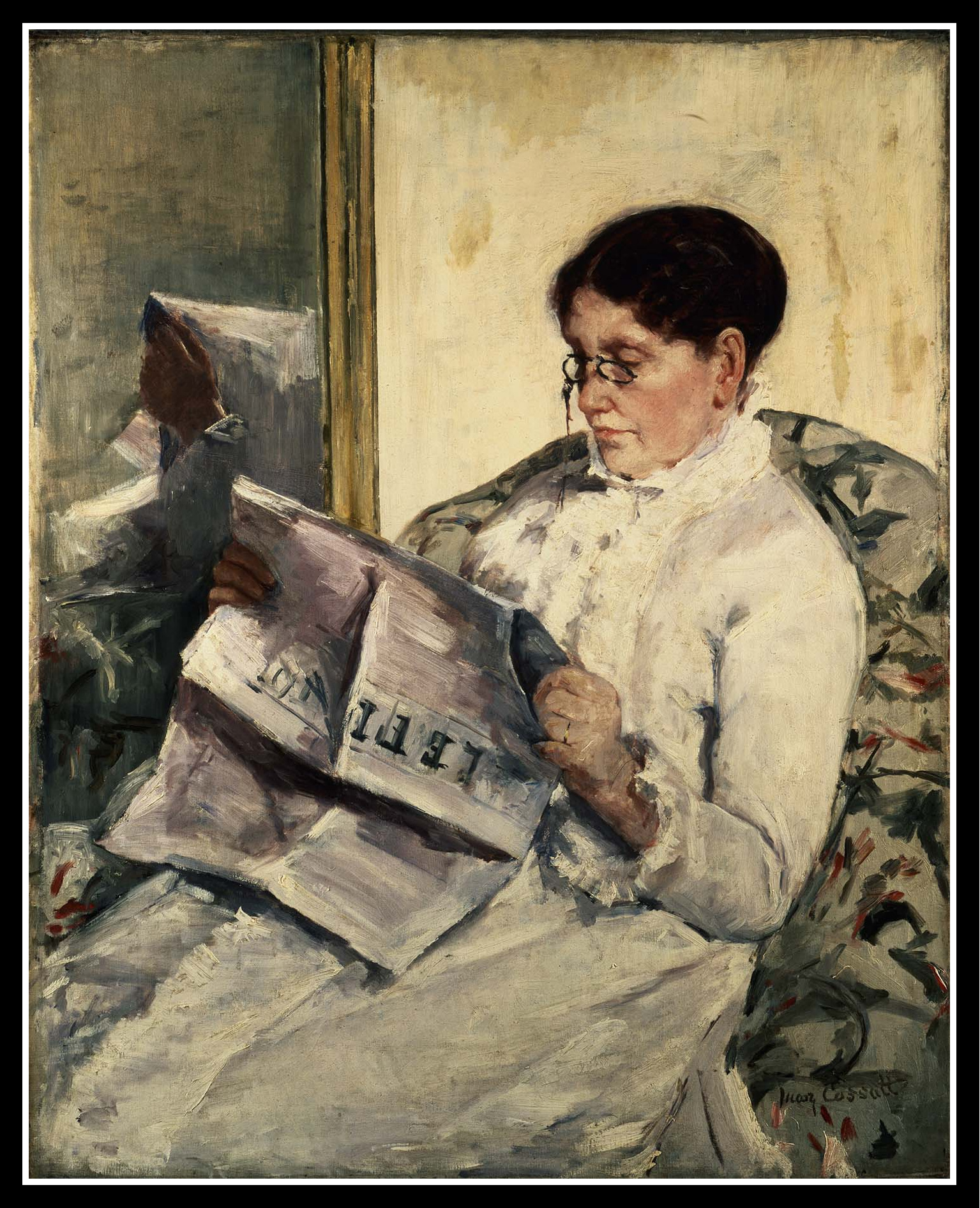
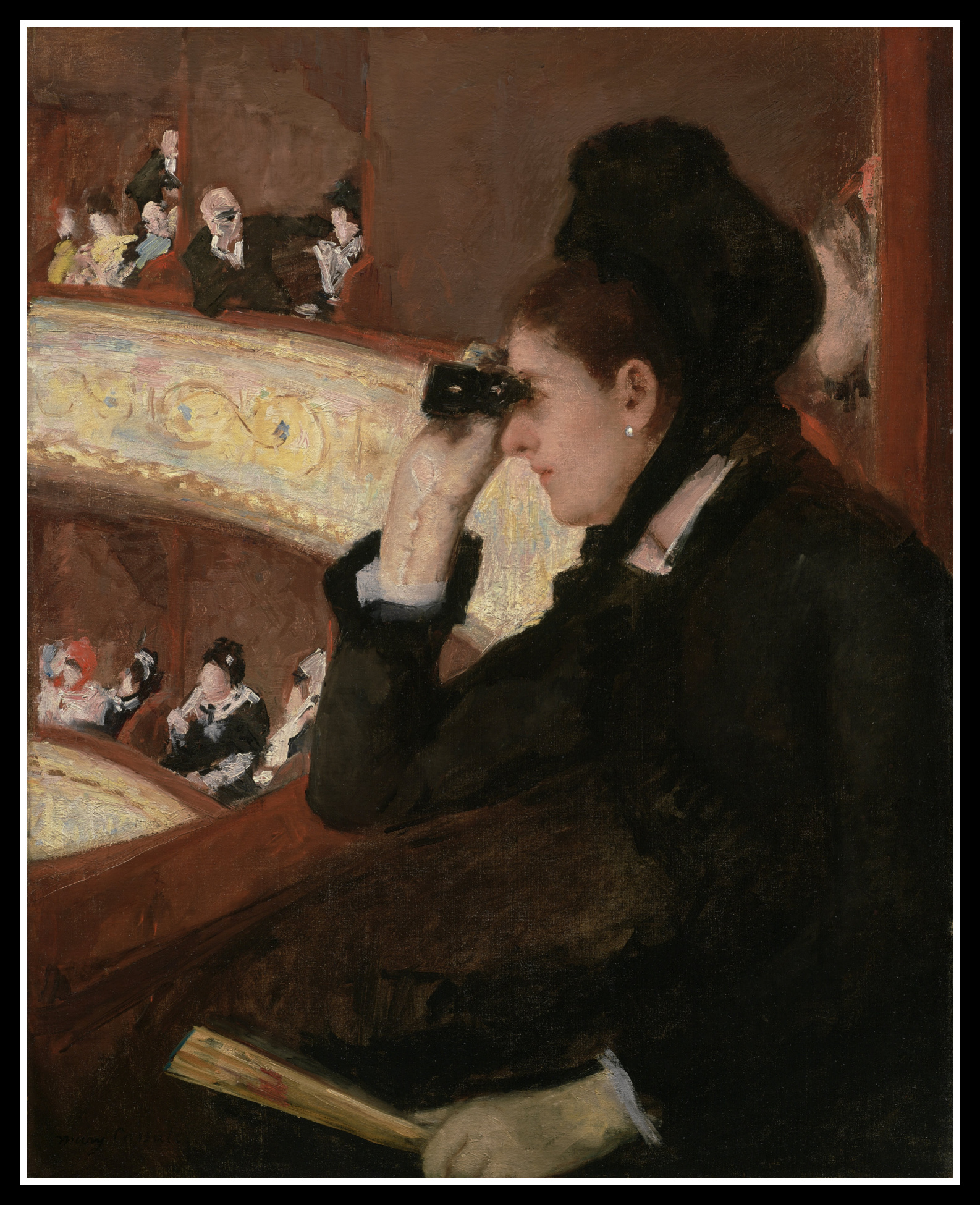
Mary’s mother, Katherine, reading the newspaper, Reading Le Figaro, 1878Look at the background of this, and the creeper staring at our heroine. In The Loge, 1878This painting caused quite a stir, one of the women’s faces is covered by a cup! Mercy! The Tea, 1880
For her entire life, Mary was always learning, always practicing, and always adapting her art as her mind, her life, and her body began to change. She made the decision to never marry, and (no shock) she had a full life of family and friends. In addition to becoming a world-renowned painter and printmaker, she assisted many people in the role of art consultant, helping them amass their art collections of various styles and artists, and made herself available to advise and support young artists.
Not only did Mary achieve her dream of an art career, she helped others achieve theirs.
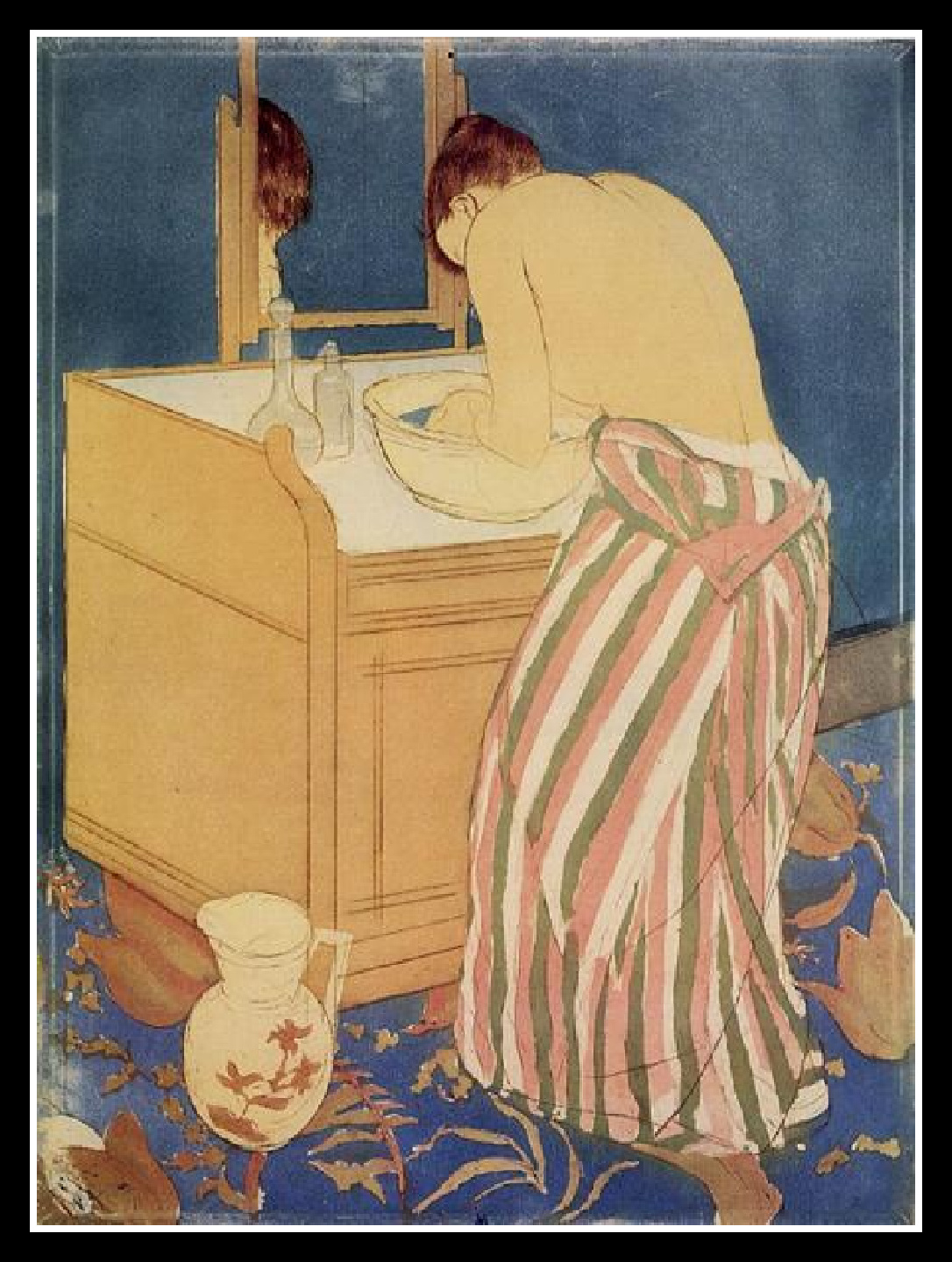
One of both of our favorites, Little Girl in a Blue Armchair, 1878Mary was always experimenting with her art, this is part of her print-making era. Woman Bathing, 1891This is the painting that Beckett was talking about that shows a very common Mom emotion. Breakfast in Bed 1897
Mary Cassatt died at her home, Chateau de Beaufresne in Le Mesnil-Theribus, France on June 14, 1926. She was 82 years old. She left behind an enormous body of work, much of which was in private collections and has since been donated to museums around the world.
****SHOWNOTES UNDER CONSTRUCTION, PLEASE COME BACK A LITTLE LATER FOR THE COMPLETE MEDIA LISTINGS****
Time Travel With The History Chicks
Books!
The biggie we used (literally and figuratively) by Nancy Mowll Mathewsby Griselda PollockLittle but thorough, by Georgette GouveiaAnd then we have some coffee table books…this one for The Art Institute of ChicagoCoffee table book by Judith A. Barter and Sue RoeBy William Cane and Anna Gabrielle
Web!
The Library of Congress has a listing of places where you can (virtually) see Mary’s work. We heart the Library of Congress.
There is a lot of information and a collection of (most) of her work at MaryCassatt.org.
Why did we keep saying that Impressionist painting was so radical? Here’s an article about that in The Week.
Very cool resource: Pieces Mary applied to be shown at the Salon in Paris, by acceptance and rejection. Impressionism.nl (and lots of other artists’ work, too!)
And we await a biopic (you know how to pronounce that, right?) let’s get on this film people, Mary had a big personality and lots of life material for a movie!
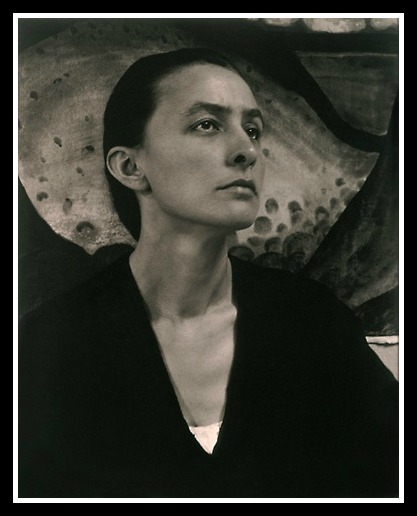
The line between Georgia O’Keeffe’s childhood in Wisconsin to her death nearly 100 years later is as jagged, complex, colorful, unique, ever- changing and interesting as the vistas outside her final New Mexico homes.
This week we’re taking a look back at one of the women who surprised us both, in the most delightful of ways-Beatrix Potter. As time and technology has allowed, we’ve gone back and quietly remastered the audio in a number of our older shows and Beatrix is the latest. When we know better, we do better! (more…)
The History Chicks Podcast
Beckett Graham and Susan Vollenweider: Two women. Half the population. Several thousand years of history. About an hour.