Every season we let you choose a winner in our Guaranteed Content Poll. We grant that request and bring Season Three to a close with your winner- The Romanov Sisters. But, we decided to give you more than you asked for and expanded on the topic to include the entire family. What an epic subject! The story of the Romanovs begins in 1613, and doesn’t really end until 2007! More than one episode could handle, so we have broken it into two parts.
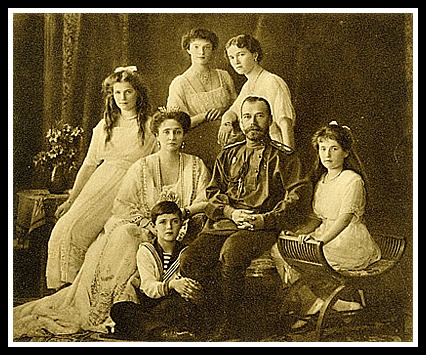
We'll chat about all of them...and more! Romanov family circa 1913
Part one begins with a Tiny Tiny Romanov Tutorial. We give a very brief history of the very long reign of this Imperial family. Beginning in 1613 when the 16 year-old nephew to Ivan the Terrible- Mikhail is crowned the first Tsar of Russia. Fast forward through time, past some Greats (and some not-so-greats) we finally land at Alexander III who we fondly call,”Papa Tsar”. He is the father of Nicholas and his death shortly after the engagement of his son to a well connected Princess begins the reign of the last Tsar, Nicholas II.
The Princess in this story was christened (deep breath) Princess Victoria Alix Helena Louise Beatrice of Hesse and by Rhine. Or Alix for short (and “Sunny” if you knew her really well).
Alix was the daughter of Alice, and Alice was the third child of Queen Victoria and Prince Albert. Not too shabby as royal lineage goes. Early in her life Alix lived up to her nickname and was sunny and happy. Then a diphtheria epidemic hit her home and Alix lost her little sister and her mother. Gan Gan Victoria did give Alix and her siblings a mother figure as often as she could while they grew up.
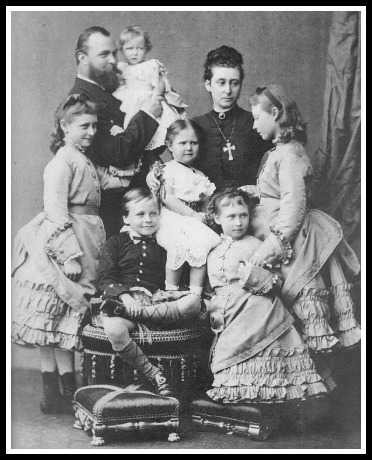
Alice and Louis and family, little Alix (in white) is leaning against her mother, looking concerned.
She also gave Alix something even less cheery and warm: Hemophilia- or rather the gene that carries it. Through her bloodline, Alix became a carrier for the bleeding disorder.
As always, we go into much more detail in the podcast, but life briefly became sunny again for her when she spent time with Nicholas. They met when he was 16, she merely 12 at Alix’s older sister Ella’s wedding. Both were smitten, however neither family was crazy about the match and tried to throw more politically adventagous suitors before both of them (as well as one that was merely designed to distract the young man). But the plots were unsuccessful and, after many years of exchanging letters, visits and flirtations, Nicholas proposed
Alix cried.
And not happy Yes! Yes! tears, either.
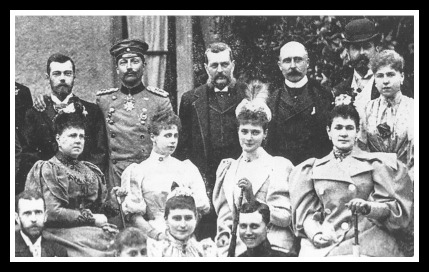
Taken at the wedding where they became engaged. Alex looking a little flirty (middle row, second from right) and Nicholas looking really uncomfortable in the arm of Cousin Willy (Kaiser Wilhelm)
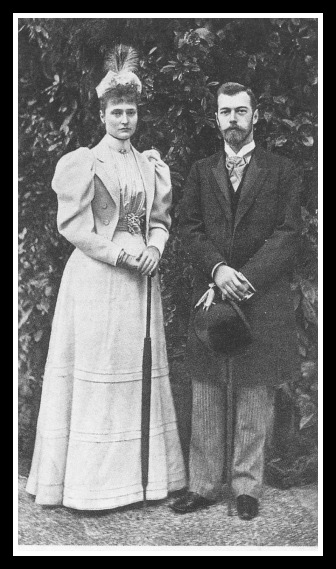
And shortly afterward (note: same clothing), the happy (?) couple
She would have to leave not only her country, but also her Lutheran faith. To become part of the Imperial family, to become the next Tsarina she would have to convert to Russian Orthodoxy. After many tears, and questionably intended drama, she accepted.
Our couple would not have a leisurely engagement. Shortly after their betrothal was announced the rapidly failing health of Papa Tsar took a turn for the worse. Nicholas called Alex to be at his side as his father passed away. For more prepared future rulers, this would have been a time of sadness as well as a preparation to step up to the role that he had been trained for his whole life.
But that’s not exactly how Nicholas felt. In the shadow of his strong father, Nicholas had grown up lacking both the temperament to rule but also the training. But with his father’s death, he had to accept his role and duty to Russia.
Nicholas and Alexandra -as her name became- were wed.
Not only was Alex now in a new country with new customs and societal rules- she had some rather unique Mother-in-law issues.
Dowager Tsarina Maria was not only unwilling to give up the life she knew, it wasn’t required of her. She stood at her son’s side, as his wife walked paces behind them, continuing with her life as it had been before her husband had passed. To complicate the situation, the newlyweds had to live with her. The wedding was so rushed that no home had been set up for Nicholas and Alexandra.
Within a year the first child, Olga was born to the couple. They both loved being parents, but were also preparing for another life change: their coronation of the new Tsar and Tsarina of Russia. The religious ceremony would establish Nicholas as the head of the autocracy, and marry him to his country in what was thought of his God given position as ruler.
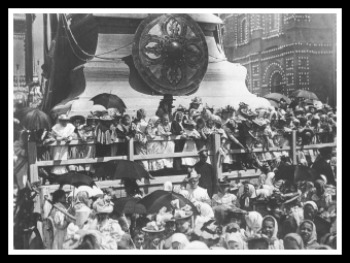
Crowds packed Moscow to witness the coronation of the new Tsar, with disastrous results.
This happy event brought out millions of spectators and, despite the falling economy of the country, no expense was spared. Parades and balls and pagentry galore- and all went well…until a stampede of spectators eager for ceremonial swag created a deadly situation. The exact number of people that were trampled to death us unclear, but up to 3,000 people died that day. How the people saw the reaction of their new ruler played a part in what will be the legacy of his rule.
Tune back in soon for Part Two of this sad story of the last Imperial Family of Russia.
TIME TRAVEL WITH THE HISTORY CHICKS
You want more Romanovs! We get that. We did, too. There is no shortage of images, websites and blogs of this Imperial Family online. We whittled down the list to our favorites and because this is a two-part subject, we are going to link you up with everything but books here. Check back for Part Two for all of our (many) book recommendations.
You want pictures and the stories behind them? You want to tour the palaces from the comfort of your home? You want to see all those jewel encrusted Easter eggs? Click on over to Alexander Palace Time Machine to get enough Romanov intel and images to keep you occupied for a very long time.
The podcast that we reference in Part Two, Russian Rulers History Podcast, can be found on your favorite podcast aggregator.
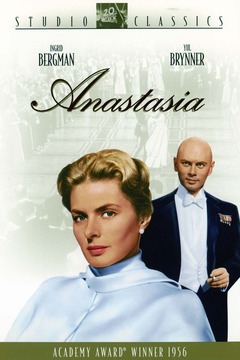
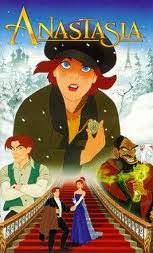
Movies! Although we end this part of our tale before Anastasia is even born, she is the subject of two films that were pretty good.
1956 Anastasia with Ingrid Bergman and Yul Brenner
1997 Animated version starring voices of Meg Ryan and John Cusak
We talk about it these movies and links in Part Two(which will make this link make sense) but you might enjoy checking out the Animated Things Club podcast.
And because it’s funny, here is a link to part one of the Frasier episode, A Tsar is Born.
As always, music comes courtesy of Music Alley. Visit them at Music.mevio.com
Often listed as merely an asterisk in history, Lady Jane Grey did have a part in the tale of the Tudors and in the succession of the crown. A teeeny tiny part, but a part nonetheless. Her young life and limited time on the throne may have been short, but it was long on drama. Did she end up remembered as the Nine Day Queen because of manipulation and lust for power? Whose? Was she a puppet or did she know what she was doing? The brief life and rule of this teenage royal is worth a bit of a chat, don’t you think? We did.
Jane Grey was born in October of 1537 (or perhaps in 1536) to Lord Henry and Lady Frances Grey. If you like a little title with your history, that would be the Marquees of Dorset and Frances Brandon, niece to King Henry VIII. Frances’ mother was Mary- the sister of Henry- and her father was Charles Brandon, Duke of Suffolk and life long frat bro of Henry. Later, after his and Frances’ brothers’ deaths, Frances would inherit the titles and she and Henry would become the Duke and Duchess of Suffolk .
Jane was also born about the same time as her cousin Prince Edward, son of Henry VIII. Linking Edward to Jane was an easy move on the part of her parents. Cousins marrying was far from unheard of, and Jane was raised with this goal in mind. To add a little more incentive to the mix – as the only son of the king, Edward was next in line to the throne. They had so much in common- Edward was was raised Protestant- just like Jane. If you have paid any attention to our ongoing Tudors series (and you should, it’s very interesting) religion plays a big part in the story. (And we always explain more in our podcast than in these notes).
Jane and her sisters Katherine and Mary (yes, we have heard those names before) were educated at home, taught to read Latin, Greek, French, Italian and groomed for well placed marriages that would bring the family more power. At nine, Jane’s guardianship was given to Katherine Parr, the then-wife of Henry VIII. Upon his death, and Katherine’s subsequent marriage to Thomas Seymour (we cover this in the Four Wives podcast) Jane’s wardship was turned over to the Seymours. Why? Because it was thought that this was the best way to arrange a marriage between Jane the new king, Edward VI- a marriage that would suit all parties involved.
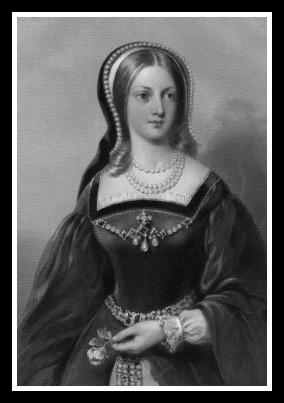
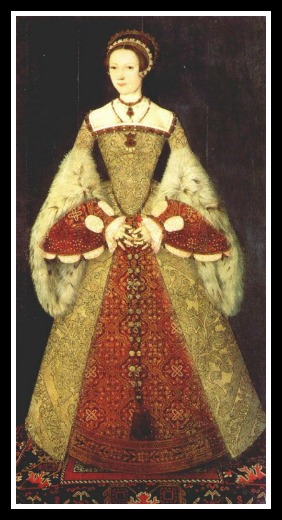
This portrait is often cited as being of Jane Grey, but there is much dispute that it is, in fact, of Katherine Parr. Actually, a great number of portraits that were believed to be Jane were proven to be someone else. Rather than be frustrated,we think it's fun to watch what we think was known reveal itself to be something else entirely. It's like a game!
But Katherine died in childbirth a short time later. And Thomas followed her to death when he was executed a year after that. Jane’s guardianship was up for grabs again, and who better to secure her future as queen than the chief counselor to King Edward, John Dudley, the Duke of Northumberland.
Dudley was a very powerful man in a sweet position, who wanted to remain that way. He knew that if Edward produced an heir, Edward’s sisters, Mary or Elizabeth, would not rule, toss him out…or worse. But if he could marry Jane to the king- who was also in line to the throne (via her mother who was willing to let it pass to Jane) he might just be able to hold onto all that was near and dear to him. Like his head.
But his plan was flawed. Edward became very ill and it was clear he would not live to marry, let alone produce an heir.
So in a swift coordinated effort with Jane’s parent’s-Dudley married 15 year-old Jane off to his only marriageable son, Guilford. It was a hot mess of a wedding that also married off his daughter and one of Jane’s sisters to well-placed men. When Edward died very shortly afterward, Dudley did a fancy dance of deceit – badda bing, Jane is Queen. Everyone is happy.
Except just about everyone who wasn’t related to Jane. The people were scratching their heads, “Queen Who?”
Except Jane who never wanted to be Queen and was frightfully unprepared for the position.
Oh, yeah, and except for Mary who foiled a plot of Dudley’s to have her thrown in the Tower of London and knew that it was her turn to rule. Mary knew that she was entitled to the crown, and she had the support of the people behind her (We do cover all of this time in the Mary I podcast).
For nine days Jane was Queen Jane. And then Mary took care of that.
Mary tossed Jane and Guilford in the tower, where they remained for several months. It wasn’t horrible living conditions, but it was imprisonment. Rumor has it that this tribute, in the Beauchamp Tower, was carved for his wife by Guilford himself . This humanizes him a bit ( which his legacy totally needs).
Courtesy Lara E. Eakins at Tudorhistory.org (see link below)
At first, Mary did not want to execute them. However, an ill-fated attempt to over-throw Mary -led by Jane’s own father- made Mary think that this decision was necessary.
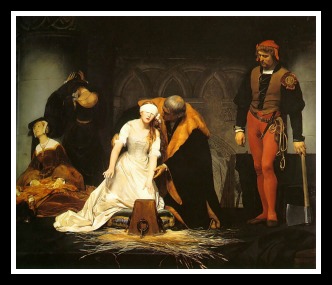
On February 12, 1554, less than a year after being imprisoned, Lady Jane Grey and her husband Guilford were beheaded.
The Execution of Lady Jane Grey by, Paul Delarouche (This one we know is her, her name is in the title)
Or this one with a very lengthy description, as well as some links to outside sources (although not all the links are currently functioning) EnglishHistory.net .
And finally, a really thorough one about all things Tudor, Tudorhistory.org
Want to travel around through the Tower of London (and other historic places of England?) not exactly like being there, but much simpler. HistoricRoyalPalaces.org
Ooh, an internet museum? Love that, lots of clicking to do on this one, although it doesn’t look like it has been updated recently. But really, unless there is new information, that’s not entirely necessary, right? Lady Jane Grey Internet Museum
Tweet what, you say? We love it when we find an active twitter for one of our women- Lady Jane Grey Info.
Of course we have some book recommendations, have you just met us?
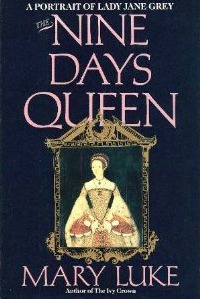
Non- Fiction: The Nine Days Queen by Mary Luke
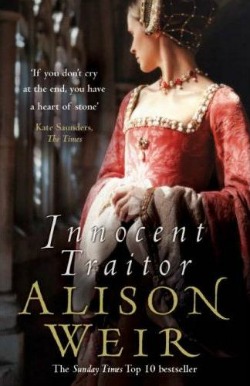
Fiction- Innocent Traitor by Alison Weir
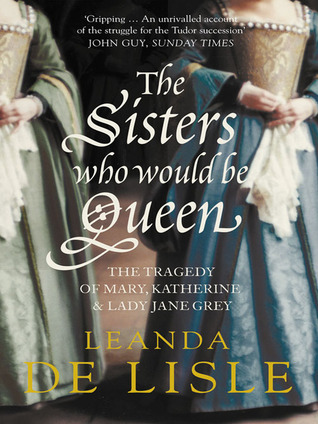
The Sisters who would be Queen by, Leanda De Lisle (Non-fiction)
And a movie, that isn’t exactly historically accurate (are any of them?) and we dare you not to have Princess Bride quotes running in your head if you watch it!
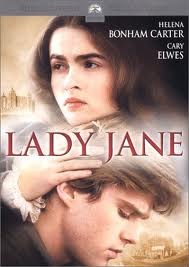
1986- Lady Jane with Helena Bonham Carter and Cary Elwes
Before she became the first Queen Regnant of England, before she was labeled illegitimate, she was, quite simply, Princess Mary of England – the apple of her father’s eye. But, ahh, nothing is simple for those Tudors. Nothing.
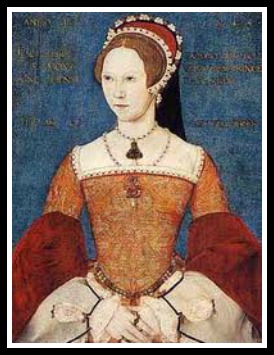
A young Mary Tudor, future Queen Mary I
We discussed the early life of Mary Tudor in the Catherine of Aragon podcast-you might want to check that one out first. In a nut shell (and we use that term pretty accurately): Henry Tudor married a Spanish princess, Catherine of Aragon, who just happened to be the widow of his dead brother. Catherine had several pregnancies, but only one child survived birth and infancy: Mary, who was born on February 18, 1516. Henry, desperate for a male heir and thinking that another wife could bring him that, went to extremes to sever his ties with Catherine.
But before he did, Mary was his ” pearl in the kingdom”. He doted on her and set her up like the princess that she technically was. She was raised royal- finest of everything and traveled from one estate to the next with her entourage. But the Princess life Mary knew ended with her parents marriage. Her new step-mom had it out for her, more so once a step-sister, Elizabeth, entered the world.
Henry and Mary had a complicated relationship- when it was good, it was very very good, and when it was bad it was rotten, (And we thought Sarah Boldger made a great Mary in the Tudors TV show so we are sticking her in here)
But Step-Mummy Dearest couldn’t produce that male heir, so Daddy ended that marriage faster than the first. Step-Mom #2 was kind to Mary and gave her a little brother but she died from complications of childbirth. Mary got along well enough with #3, but that marriage didn’t stick and #3 was transformed into an Aunt. Step-monster #4 wasn’t around long enough for Mary’s distaste of her to cause too much trouble, and Step Mother #5 was the fairest, and kindest of them all and saw Daddy King to his death. With that, Mary’s ride on the Step-Momcoaster came to a complete stop. Little brother Edward became King, and Mary set off to a well provisioned life. (See our podcast and shownotes from Episode 24: Last Four Wives for more details about this time.)
Mary had inherited quite a bit from both of her parents. From her mother she had her deep Catholic faith, and a stubborn streak that helped her hold her ground. From her father she had gained great wealth, much land…and a stubborn streak. During Henry’s life Mary and he had many years where the two battled with stubborn and manipulative weaponry. After his death, she put those tools away during her brother’s reign.
And then he died. King Edward VI ruled for only six years and died at the age of 15. Because of his young age, a Regency Counsel made most of the decisions for him in regard to ruling. A Counsel made of men. Some of those men with ambition and drive and lust for power. As with everything, we do go into detail in the podcast about all of this and sum it up here: upon Edward’s death there was some confusion as to who would succeed him. Henry VIII had mapped out the line in his will-Mary would be next. But members of the Counsel schemed a way around that, and for a very brief time that person was determined to be Lady Jane Grey.
Mary was having none of this. She whipped her royal blood into a well executed bid for the crown, and won. (This is the extremely abridged version).
At the age of 37 Queen Mary I was crowned.
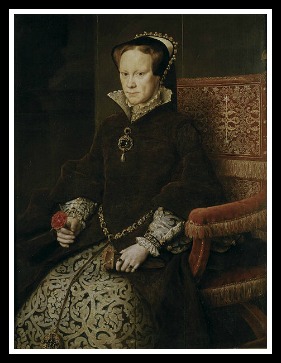
Queen Mary I by, Antonis Mor
First up on her To-Do list: Convert England and her realm back to Roman Catholicism. Papa and Brother King had allowed Protestant faith to become the official religion, but Mary was a very serious Catholic. She had a few hurdles in the way but worked with Parliament to make it so, (number one…get it?) She ultimately threw her royal weight around and enforced heresy laws which allowed those practicing religion other than, and speaking out against the religion of the land to be executed. Specifically, burned at the stake.
It’s not a pretty time in history. Despite the nickname that would follow her through time- Bloody Mary- it wasn’t the first time this law had been practiced. Her own father and brother had also executed many for similar religious reasons. (And don’t get us started on what her Spanish grandparents did.)
Also up on Mary’s list: Find a husband and produce an heir. She checked off the former with Prince Phillip II of Spain, but the latter was never to be. She had two phantom pregnancies and never had a child.
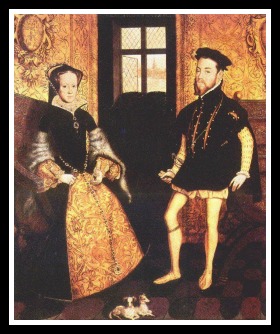
This is the odd portrait that we discussed in the podcast
Mary ruled for five years. In that time she had a complicated relationship with her half-sister and next in line for the throne, Elizabeth. Her relationship with her husband was also strained- he didn’t seem to be in it for more than political gain, and she was unable to provide an heir. By the end of her life, he was living and ruling in Spain and their time together had been minimal at best.
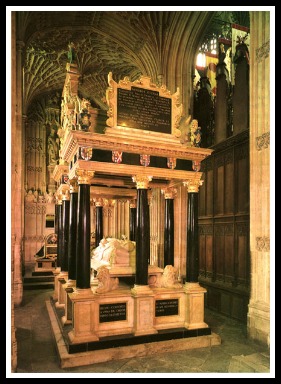
Mary died at the age of 42, and Elizabeth I was crowned. Mary’s original tomb was ruined over time. When Elizabeth died, James I buried both sisters together in the same tomb and that is where they lie now. With an effigy of ELIZABETH atop them both.
Final resting place of Mary and Elizabeth
Time Travel With The History Chicks
Want to get a Mary I ditty stuck in your head? Horrible Histories has one for you.
Good site for middle grades (or a quick read ) and LOTS of extras to click on: Tudorhistory.org.
Of course there is the Showtime series, The Tudors where Mary’s story is shown with a heavy hand for the dramatic, not quite historically accurate but always riveting. If you are a fan, or want to discuss it, check out TheTudorsWiki.com
Books! We know you love your books and these are the ones that we recommended during the podcast:
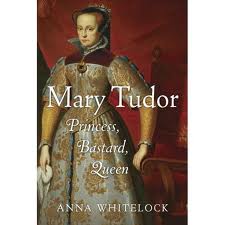
Mary Tudor: Princess, Bastard, Queen by, Anna WhitelockThe First Queen of England by, Linda PorterThe Tudors by, G.J. Meyer
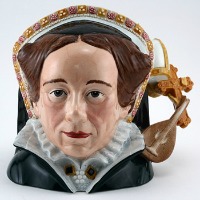
Just because we can: Like Mary’s mug? At this writing Seaway China Company is sold out, but maybe you can find one of these Royal Doulton mugs to use at work. Especially handy if you have the unpleasant task of firing someone. (Royal Doulton has an entire line of Royal mugs like this.)
Is it just us? She looks a little tired, right?
You might want to research the origins of some of your favorite nursery rhymes. Mary, Mary Quite Contrary has a little debate surrounding it. Was it about Mary Tudor, or her Aunt Mary Queen of Scots? You decide. Mother Goose Club has a lot of info or Secret Rhyme Origins has a bit, too.
As always, our music comes courtesty of MusicAlley. Visit them at Music.mevio.com
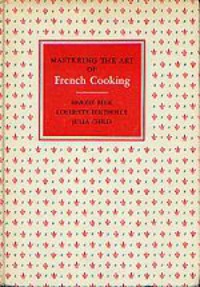
I’ll confess: That title is a little misleading. Julia was only with me in spirit one hot day in July. I was mid-researching her life for the podcast and was inspired to crack open her first book, Mastering the Art of French Cooking. I love the title- it sounds so romantic, so dreamy. It’s also kind of ironic since Julia’s approach to cooking was that of a scientist. Her methodology and her recipes- test and re-test, measurements precise and the directions exact.
(X Eggs+ Y Cream)+(Z Temperature+ A minutes)= souffle. Every time. Science.
But Mastering the Science of French Cooking probably wouldn’t have appealed to the servantless American housewife of 1961, and it sure would not have appealed to me, a servantless American housewife of 2012. But Julia Child was part of my upbringing, her books part of my home cooking education. Reading about her life- who she was beyond the recipes and the TV personality- inspired me.
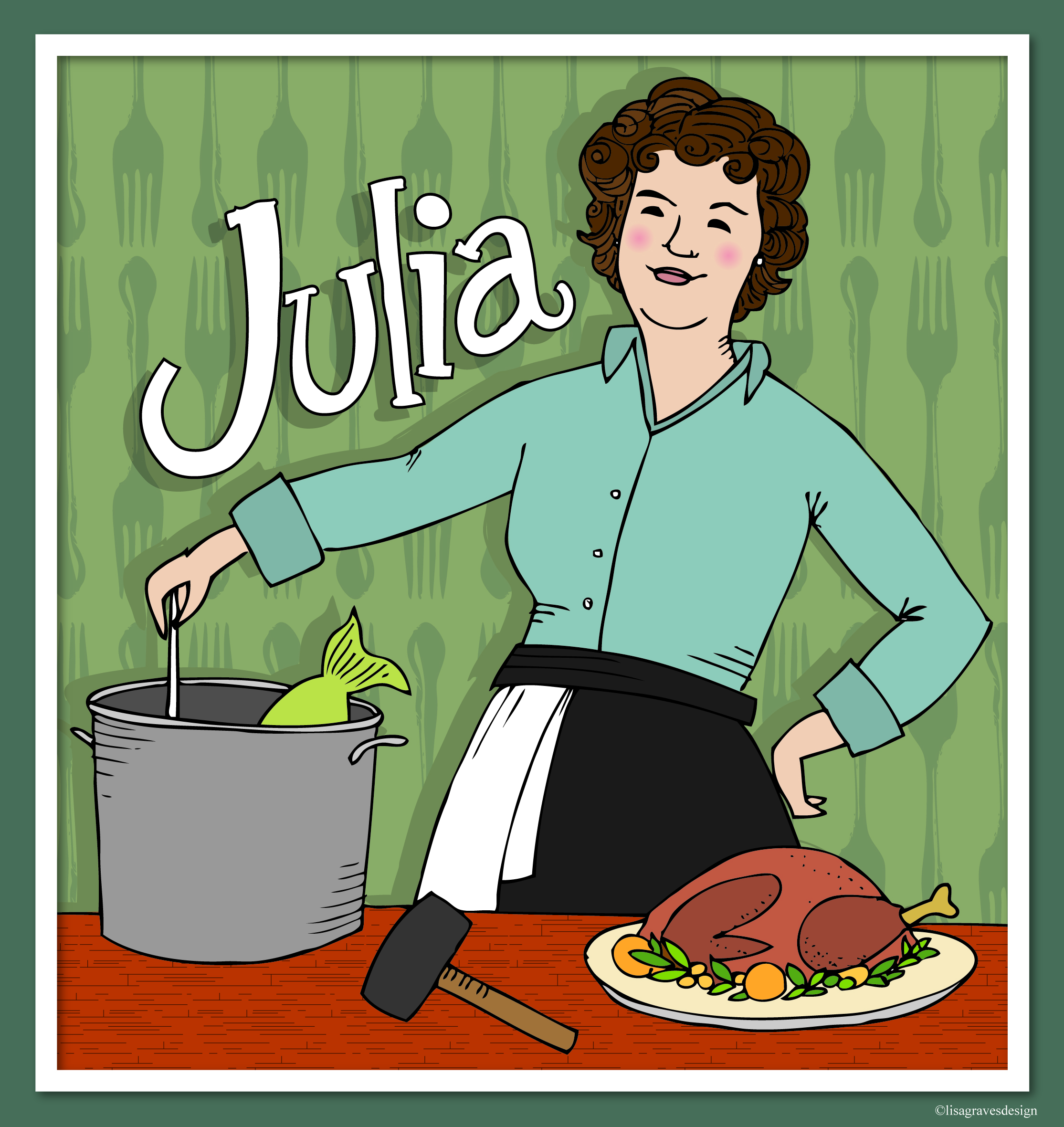
Courtesy Lisa Graves Designs
Let’s get some things straight:
I’m not a foodie. I am a decent home cook, but I am a thirty minute cook. If dinner doesn’t come together in thirty minutes, I usually don’t make it.
If it takes a lot of pans, I usually don’t make it.
If it’s expensive, I really don’t make it.
But Julia helped create Mastering the Art of French Cooking for the average American housewife. Trust me when I say- they don’t get more average than me.
Enter: French Chef Dinner night.
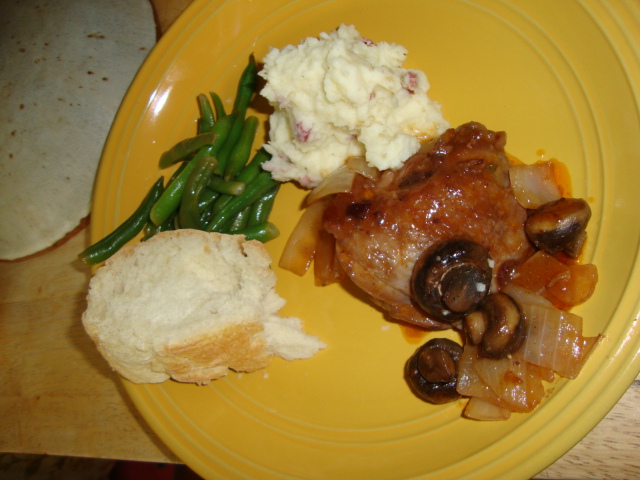
Coq au vin, parsley potatoes, fresh steamed green beans and pear and almond custard tart for dessert.
The plan was to do it right- not take any shortcuts. From shopping to serving all in one day-, each step savored and enjoyed with a Frenchified American accent. I was going to have a day of lovingly preparing food for my family. In my head they oooh’d and ahhh’d at the results, they lavished me with adoration…
Like most overly romanticized plans, it didn’t actually work out the way I had imagined. I did shop, prepare and serve my family a dinner straight from Mastering The Art of French Cooking. I also spent the day taxi-ing my three children to camps and activities in 104 degree heat. I don’t have enough romantic in me to make that day dreamy. It was work.
And I took shortcuts. I like coq au vin with dark meat, but two of the people at the table of six that I serve dinner to each night will only eat white meat. Precut and packaged meat won me over.
The pearl onions that I wanted to use would have cost me close to 10 dollars for the quantity that I needed. I couldn’t shut up my inner cheapie long enough to toss them in my shopping cart.
The grocery store was out of baguettes which Julia would have purchased. I did toy with the idea of making my own bread (I’ve done it before) but frozen dough won me over as a nice compromise.
And I grabbed a package of premade pie dough on the off chance that I didn’t have time to make the sugar pastry crust that Julia recommends for the tart.
Now that it’s all spelled out- I took a lot of shortcuts.
I did get to banter some French phrases around at the check out lane. I told the cashier, “Bonjour” and “Fantastique” when she greeted me and asked how I found everything. When the total came to four times that of a normal dinner for my family, I uttered the one French cuss that I know.
(Note to self: Don’t banter French phrases around in small town grocery stores unless a) you are in France or Canada or b)you want to hear crickets and see dental work.)
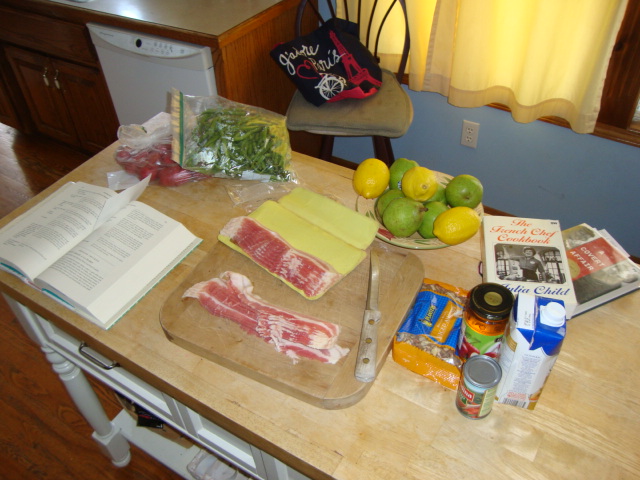
At home I set to work. First up: bacon. (Honestly, a day that begins with frying bacon can’t go bad, can it?)
Shopping finished, I began to cook.
I cut fresh herbs from the pots on my porch, sliced onions, cleaned button mushrooms and played scientist with them in pans of butter.
My herb garden, some of it made it into the dinner
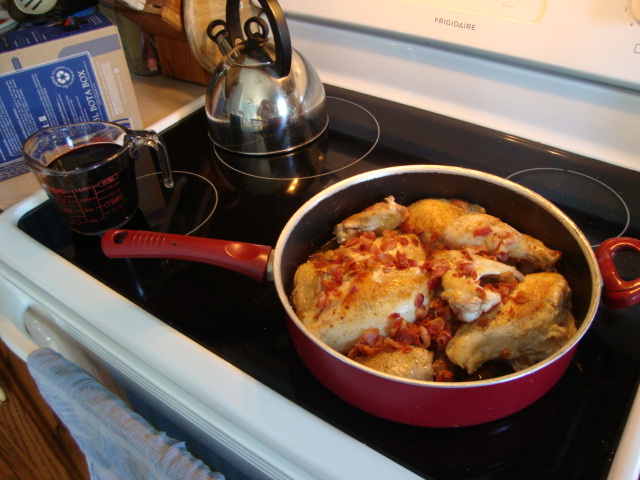
While the fifty minutes that the onions were supposed to braise in chicken broth astonished me, the entire preparation of the entree was fun. It was. Wine! Bacon! Beautifully browned chicken! What’s not to love?
Yes, that is a Bota-box. Don't judge.
It was the rest of the meal that reminded me why I am a 30-minute cook.
By the time that the bread had finished cooking, the outside temperature was nearing 104 degrees, and the kitchen temperature wasn’t too far behind. Time was also getting away from me, and the thought of the mix, chill, roll, chill then bake of the sugar pastry crust added more time and more heat. The filling took a lot of both and really, my family never would know what they were missing.
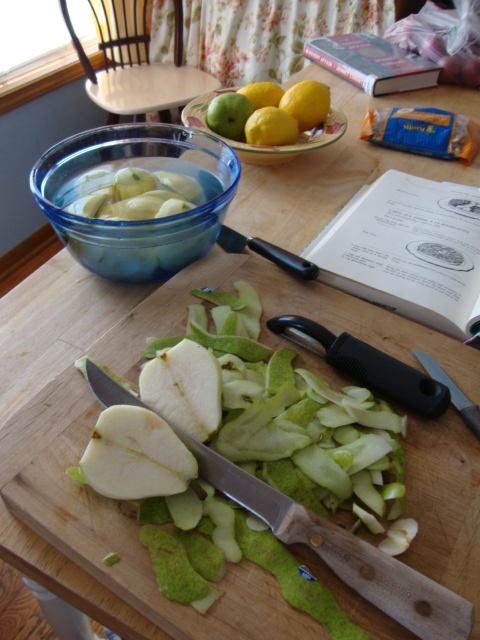
Peeling, coring and slicing the pears that were then poached for far longer than Julia had said they would need to be.
While the pears poached, I beat the custard as it cooked. You thought I would beat by hand? hahahahahno.
Almond custard in crust
Finished.
Upturned noses when I mentioned,”boiled parsley potatoes” altered the dish to mashed red potatoes. Not a big deal, Julia would have rolled with it, right?
Eight hours, and nearly a pound of butter, after I began I was serving dinner.
A food blogger I am not. Dinner, is served
I would love to be able to carry on about the reaction of dinner. That my family enjoyed it all the more because of the time and energy that I spent cooking it…but the truth is far from that. They liked it. They devoured the potatoes and one scraped the sauce off the chicken. My darling husband actually had the nerve to say, “Did you cook this in the crock pot?”
Oh, sigh, yes, he did.
But Julia taught me to enjoy the process, serve the results and never apologize. Two out of three ain’t bad.
I really liked the meal, the chicken was wonderful and the dessert was really fantastic. Would I do it again? Probably not. It was a lot of work and only some of it was enjoyable. But I’m glad that I took a day to remember Julia and cook a dinner in celebration of her memory.
Happy birthday, Julia!
If you haven’t listened to the podcast on Julia, click on over here, or listen via iTunes or on Stitcher Radio.
Julia Child- the iconic and effervescent television personality who brought french cooking to servantless American homes. On television she boldly demonstrated the ease of preparing the foods that she loved. People have been learning to cook with her since her first cookbook was published in 1961, and her television show, The French Chef hit the airwaves a couple of years later.
Courtesy Lisa Graves Design
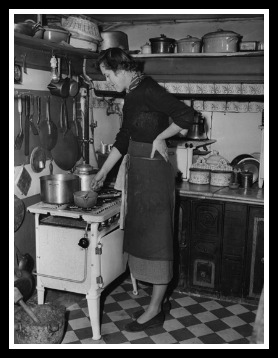
Julia in her kitchen in Paris
This is how we think of Julia: stirring and whisking and slicing her way through France. But she was mid life when all of that began- in this episode we talk about her life before she became the face of French cooking in American homes. We chat about her upbringing in Pasadena, CA, her education at Smith College, her early career as a well traveled file clerk, and the romance with Paul Child that really changed her life.
August 15, 2012 would have been Julia’s 100th birthday, and in celebration we sat down to talk about her life, her loves, her adventures, her politics and her food.
Born Julia Carolyn McWilliams in 1912, she grew up in an affluent home, attended private schools and had, what she described as a, "butterfly life."
While serving in the OSS during World War II, Julia met Paul Child. They married and she moved with him to France where he was stationed as a diplomat.
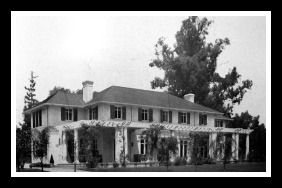
The apartment building in Paris where the couple lived is sort of a foodies mecca even today. People make a point to stand in the doorway of this famed address to have their picture taken.
While in France, Julia fell in love with the country and the food. She attended and graduated from the famed Le Cordon Bleu cooking school. (As it looks today)
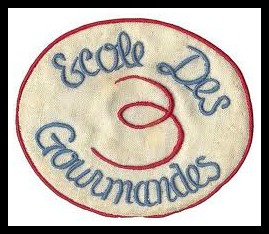
After graduation, Julia teamed up with two French friends and began L'Ecole des Trois Gourmandes,( 'The three hearty eaters"), and taught private cooking lessons to American women in Paris. The two asked Julia to consult on a cookbook that they were writing. The next nine years of her life was devoted to writing that book: Mastering the Art of French Cooking.
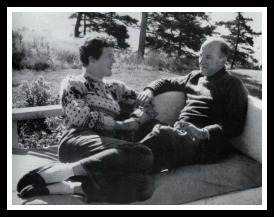
Julia and Paul supported one another both in Europe and America as they were faced with challenges and successes in their lives.
Time Travel With The History Chicks
Our stack of Julia books was rather impressive, and we liked several of them:
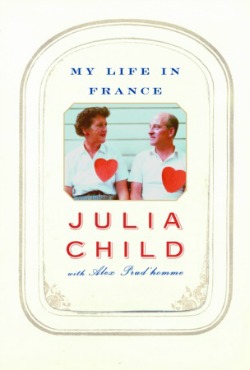
This is the one that we would recommend if you want to read just one book about her life. Her voice will be in your head by the end of the first chapter.
My life in France, by Julia Child and Alex Prud’homme.
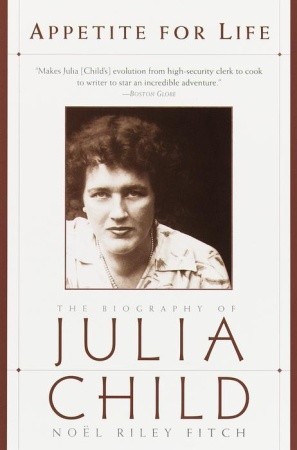
Another complete biography of her life that we can recommend:
Appetite for life by, Noel Riley Fitch
We can’t recommend this one, simply because we didn’t read it (yet). But if you did, drop us a line and let us know what you think.
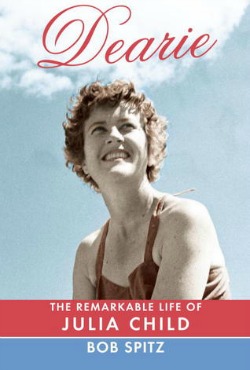
Dearie by Bob Spitz
If you like reading letters, and like peeking into conversations of women (and you know you do), this one is interesting:
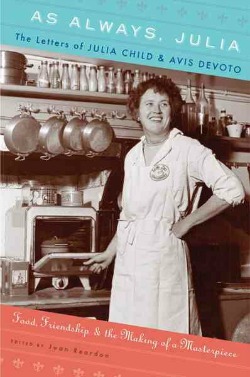
As Always, Julia edited by Joan Reardon. Letters between Julia and Avis Devoto
Of course, you could crack open The Book and cook like Susan (did one night)
Or cook like Beckett (would if she wanted to cook)
The two children’s books that we thought were very charming:
Minette's Feast by Susanna Reich illustrated by, Amy Bates
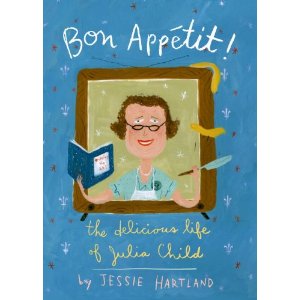
Bon Appetit: The delicious life of Julia Child by, Jesse Hartland
Archive of American Television Three hour interview, very interesting if you want to hear about her life from Julia herself.
Interview in Coping Magazine about Julia’s experiences with breast cancer in 1965.
Movies…well, there is this one (Also a book, and formerly a blog):
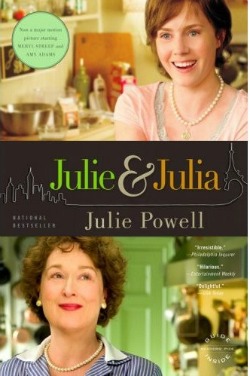
Movie and book- Julie and Julia by Julie Powell (Movie directed by Nora Efron)
The grant giving organization that Julia founded to help her legacy and passion live on through others, The Julia Child Foundation. This site has lots of pictures information and a really interesting timeline that is great for kids.
Beckett recommended the webcam at Boulangerie Bonneau in Paris : http://www.bonneau.fr/live/ (they don’t make bread on Mondays and Tuesdays)
Finally, if you enchanted by the Lisa Graves illustration of Julia that was created for us, (posted at beginning of this shownote) you really should check out her website: History Witch. Her short and funny highlights of historical women as well as her whimsical illustrations may charm you like they did us.
As always, music comes courtesy of Music Alley. Visit them at Music.mevio.com
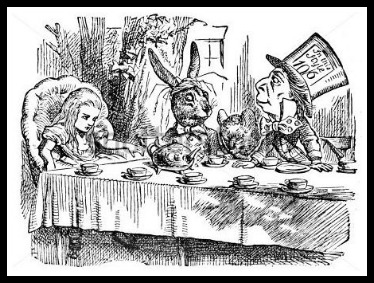
This minicast deals solely with the books: Alice’s Adventures in Wonderland and Through the Looking Glass and What Alice Found There, both by Lewis Carroll with illustrations by John Tenniel. We take a chapter-by-chapter look at the two books, talking plot points, characters, and behind-the-story tales.
The first book carries a playing card based theme, and the latter evolves around a game of chess. But these are only the surface references within these stories, the many elements that make them up are far too numerous to be contained within even an hour long podcast. The study of them is a major undertaking. We admit it- we are not Carrollian scholars, but we do know some stuff.
For instance, some of the references in the books are only understood if you are aware of the era in which the books were written. Some only if you are knowledgeable in the eccentricities of Oxford, England. And some only if you belonged to, or knew details of, the Dodgson or Liddell families. Even more exciting, Lewis Carroll tucked so many mathematical terms, riddles and word play into the two books seeking them out would be a fantastical hobby in and of itself.
For this minicast we go chapter by chapter and discuss not only the storyline, but some references within it. We talk about some of the characters in the book as well as some of the poem satires and forgotten characters.
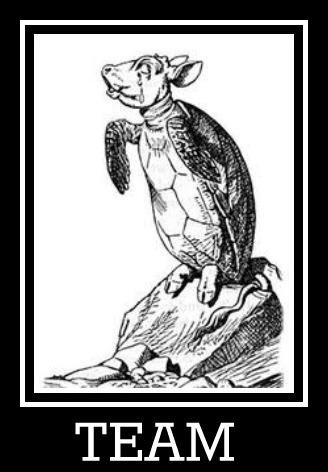
Beckett does not want the poor, oft- forgotten Mock Turtle ignored.
And we might sing a little teeny tiny bit, too.
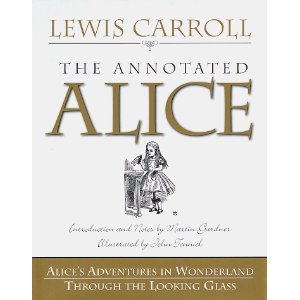
Please give a listen for more details. If you are interested in learning even more “special features” about these two works, we suggest that you begin with The Annotated Alice by Martin Gardner (with the original Alice illustrations by John Tenniel).
If you would like to see a really creative illustration collaboration with the original text, Alice’s Illustrated Adventure is a really fun blog. The tag line: “Written by Lewis Carroll and illustrated by Almost Everbody” sums it up.
Both books are available in audiobook form, free of charge, in ITunes. Simply search for the Librivox name with the title you would like. There are unabridged and abridged versions of them both.
But, be warned, that may be only the beginning of the adventure for you!!